GCC Blueprint

From strategy to a working GCC: what experience teaches

Built on about two decades inside global capability centres and shared services, from processing transactions to advising CFOs on how to build them. GCC Blueprint distils that experience into ten phases, from defining what the centre is for to its first year of value. For each phase: the big picture, the decisions that matter, the approach that works, and where organisations go wrong. One size does not fit all, so each phase also shows how it differs by organisation.

With curated insights from 7 specialist GCC advisers and research firms, credited and linked on every phase. Framework drawn from The GCC Advantage, Parts 1 to 3.

The sequence that matters

Mandate defines scope. Scope defines model. Model defines location. Leaders who reverse this, by picking a location and working backwards, consistently under-deliver.

Before you start

One size does not fit all

GCC Blueprint is a structure, not a template. The ten phases hold for every organisation, but the right answer inside each phase depends on who you are: your ambition, your starting point, your systems, your sector and your constraints. Two companies can follow the same phases and, rightly, build very different centres.

The variables that shape your build

  • Ambition

    Cost and efficiency, or capability and transformation?

    Shapes: The mandate, the model label, the talent you hire

  • Scale

    A first centre for a mid-size firm, or one more site in a large portfolio?

    Shapes: Delivery model, governance, how much you build yourself

  • Sector and regulation

    How sensitive is your data and IP, and who regulates you?

    Shapes: Location shortlist, delivery model, technology design

  • Starting point

    Greenfield, existing shared services, work coming back from a provider, or a BOT to transfer?

    Shapes: Which phases you can compress, and which need a reset

  • Process and system maturity

    Standardised processes on one ERP, or a fragmented landscape?

    Shapes: Scope, tower design, the pace of waves

  • Talent profile

    Broad, high-volume skills, or scarce specialists and languages?

    Shapes: Location, pay position, employer proposition

  • Capital and timeline

    Pressure for results within a year, or a long-term build?

    Shapes: Delivery model, the business case thesis, wave one

  • Sponsorship and culture

    How strong is executive sponsorship, and how ready is the organisation to let go?

    Shapes: Governance, change management, how ambitious wave one can be

  • Geography

    Where do your stakeholders and customers sit, and in which time zones?

    Shapes: Location portfolio, operating rhythm, coverage model

Same ten phases, different paths

Illustrations of how the path changes. Every phase shows how it differs by organisation.
The journey

  1. Decide

    Settle what the centre is for, and win the decision to build it.

    1. The mandateDecide what the centre exists to do, and what success looks like in years 1, 3 and 5.
    2. The business caseWin approval with a strategic story, an honest model and a staged ask.
  2. Design

    Make the structural choices that are hardest to reverse.

    1. The delivery modelCaptive, managed or BOT, or hybrid: choose by five factors, and design the next evolution in.
    2. LocationA ten-year decision: score the shortlist on six weighted factors, not on cost alone.
    3. Scope and towersFilter what belongs, group it into towers, own processes end to end, and phase in waves.
    4. The operating modelFour explicit decisions: delivery architecture, governance, business relationship and performance.
  3. Build

    Put the people and the infrastructure in place before go-live.

    1. Leadership and talentHire the GCC Head first, design the employer proposition, and plan talent across three horizons.
    2. Technology and infrastructureFive layers, decided before launch: systems, connectivity, collaboration, data, and process intelligence.
  4. Launch

    Move the work, survive the first year, and start compounding.

    1. TransitionReadiness, knowledge transfer, cutover, stabilisation and hypercare exit, with no stage compressed.
    2. Stabilisation and early valueFrom fragile continuity to resilient performance, with 90-day wins and a Year 2 roadmap.

Five ways GCCs fail, and where each is prevented

  1. The absentee sponsor

    The sponsor champions approval, then hands execution to someone without the authority to settle the hard disputes.

    Countermeasure: A named sponsor with written weekly hours and a fast escalation path.

    Phase 1: The mandate
  2. Scope set by politics

    The centre inherits the least contested work instead of the most transferable work.

    Countermeasure: Objective scope criteria agreed before anyone is consulted.

    Phase 5: Scope and towers
  3. The talent arbitrage trap

    Hiring at the bottom of the market and discovering that much of the job was knowledge, not process.

    Countermeasure: Pay at or above the location median and build real career paths.

    Phase 7: Leadership and talent
  4. Governance as paperwork

    Steering committees that receive information instead of making decisions.

    Countermeasure: Governance designed for decision speed, with clear decision rights.

    Phase 6: The operating model
  5. Change management as an afterthought

    The onshore team quietly obstructs a change nobody helped them through.

    Countermeasure: Change management run as a funded delivery workstream from day one.

    Phase 9: Transition

How specialist firms map the journey

Advisers describe the same journey in different stages. Comparing them is a useful check that nothing is missing from your own plan.

GCC Blueprint

  1. Decide
  2. Design
  3. Build
  4. Launch

Zinnov

  1. Strategy
  2. Establishment
  3. Launch
  4. Scale
How to Set Up a GCC in India: A Four-Phase Approach

Avasant

  1. GCC strategy: whether, where and how
  2. Transaction execution: select and contract the partner
  3. Implementation: stand the centre up
  4. Benchmarking
  5. Value creation
  6. Carve-out, when strategy changes
GCC Consulting

After go-live

GCC Blueprint ends where the centre starts compounding. The rest of the journey is covered in the book and in these series.

Go deeper

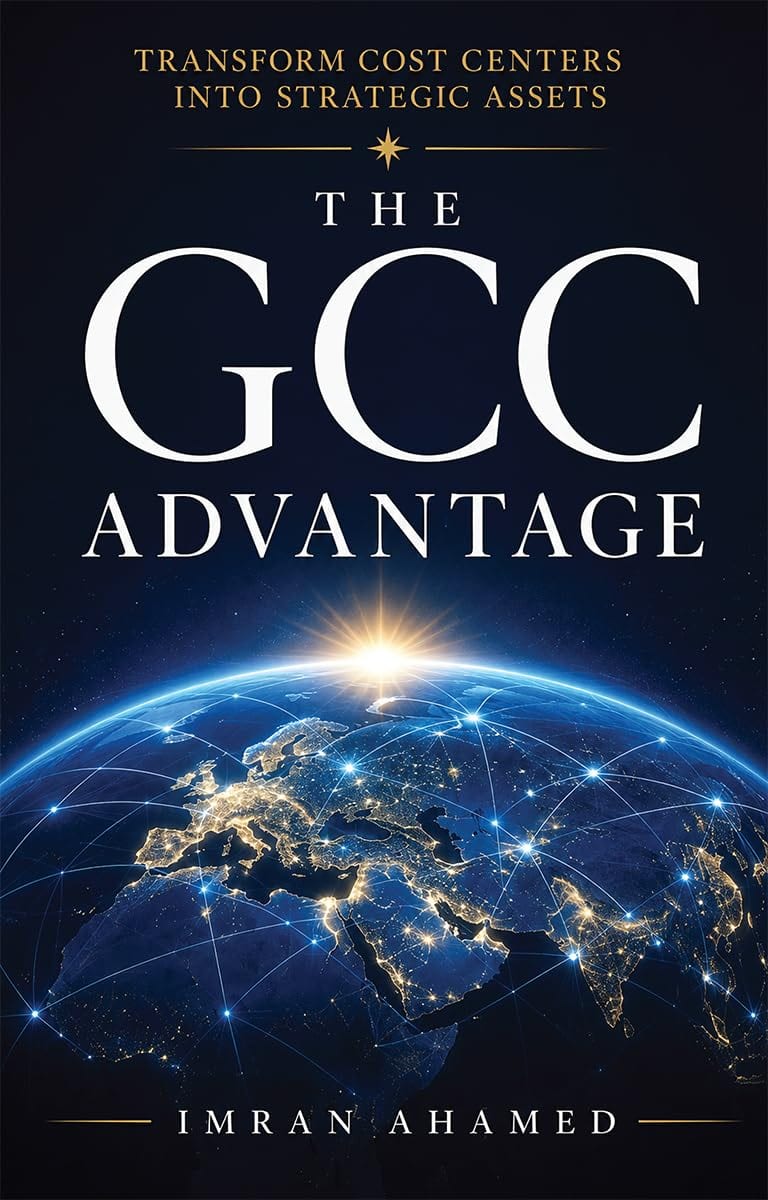
The GCC Advantage

Every phase here is a chapter in the book, with the full reasoning, examples and checklists.

About the book

Insights and credits

The specialist insights on each phase are summarised in our own words from the published work below. Each was checked against its source in November 2026. Citing a firm does not mean it endorses GCC Blueprint; the framework itself is from The GCC Advantage.